GoodBed helps you find the best mattress for you, whether online or in a local store. If you choose to buy a product through the links on this site, we earn a small referral fee that supports our work at no cost to you. Here's more info about how it all works.
The Plank mattress is aimed at people who want the firmest possible mattress. Just how firm is it?
The Plank is exactly what the name suggests: a mattress aimed at those who prefer a super-firm bed. The manufacturer says that it's for people who "say a typical firm is never firm enough."
And overall, it is just about the firmest mattress we have tested to date. We reviewed the mattress when if first came out a couple of years ago. Now we have take a fresh look at the mattress, along with a new feature: Cooling cover panels that are an option (at about an extra $125).
The Plank is an all-foam mattress (a hybrid version is also available but not reviewed here). Most extra firm beds we've seen are traditional innerspring or hybrid innerspring beds, but the Plank's all-foam construction means it compresses and rolls up into a box that arrives to your door via common carrier.
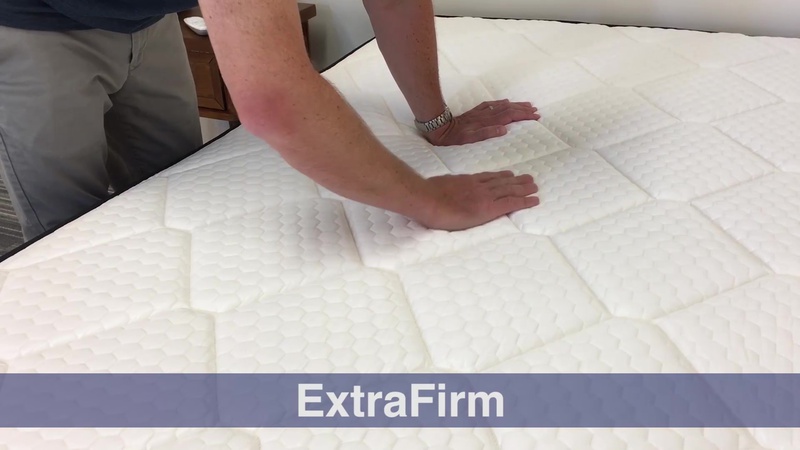
This bed also has two sides--a nice option for those who want a very firm mattress but maybe are not quite sure just how firm. Plank calls one side "Ultra Firm" and the other simply "Firm". We did notice a difference between the two. On our softness classification scale, we would call the Ultra Firm side an Extra Firm and the other side just barely a Medium Firm, and very close to a Firm. The effect of sleeping on the ultra firm side reminded us of laying on a very plush carpet, or one of those slim camping mattresses, or even a softer futon-type mattress. All that is to say that indeed, this is an exceptionally firm mattress.
As you might expect when choosing an extremely firm mattress, you may make some compromises in spinal alignment. Our tester felt well supported when sleeping on his back and stomach, on both sides of the bed. But side sleeping from both a spinal alignment and pressure relief standpoint was more challenging -- no surprise given the firmness of the bed. But if you are a back or stomach sleeper that knows you prefer very firm support, then the Plank may be worth consideration.
Pluses in our testing include very good edge support (especially for a foam bed), and excellent ease of movement. We found mixed results in our test for adjustable base compatibility; this is not a bed that wants to bend (it's called "Plank" after all), and the mattress did not conform very well to our base out of the box.
From a value standpoint, the Plank bed is competitive with much of the online competition, but we found this to be a unique bed, and one that's hard to find online or in stores -- a mattress that's aimed at those who really prefer a very firm bed.
Read on for our detailed report, and be sure to check out the video to see this mattress in action as we put it through our tests. Note: We mainly tested the Ultra Firm side of the mattress, but do include our notes on the Firm side as well.
Note: Brooklyn Bedding was early to the online-mattress game, and now has a variety of models in its lineup. This review covers the Plank, an extra firm all-foam mattress. We have also reviewed the Brooklyn Signature mattress, a hybrid bed made with foam over pocket springs. Also see our review of the Brooklyn Aurora mattress, a more expensive hybrid bed made of foam and memory foam over pocket springs, and with several specific features to keep you cool.
The “feel” characteristics of a mattress cannot be universally better or worse.
They can only be more or less desirable to you, based on your personal preferences.
For this reason, we call these “preference-based” attributes.
Our ratings here are based on objective measurements that we apply to a consistent scale for products from all
brands.
The Plank bed has two sides; one called Ultra Firm, which on our scale we would call an Extra Firm. It's just about the firmest mattress we have tested, and the effect is a bit like laying on a very plush carpet, or one of those thin mattresses used for camping. It would also compare to a softer futon. The flip side of the bed is what the company calls Firm. We would call it a Medium Firm, but to the firmest side of Medium Firm, very close to a Firm.
Not sure what softness is best for you? Take our Mattress Match Quiz and find out.
As one of the firmest mattress we have tested, it's unsurprising that the Plank doesn't allow you to sink much at all. Cushioning depth is what can give you a "hugged" or "cradled" sensation from a mattress versus more of a "floating on top" feeling, and the Plank is definitely the latter.
We look at responsiveness in two ways. First, we examine how quickly a mattress springs back after being depressed, then we take a look at bounce qualities.
Since the Plank mattress does not include any memory foam, we were not surprised to find that it did not have any of that slow-responding melting quality of memory foam. Rather, it springs back into position quickly.
As for bounce, we would not expect much (if any) from an all-foam mattress, but the Plank did have a little what we call mid-level bounce -- the type of bounce some couples prefer. There was hardly any bounce right at the surface, or deep bounce, where your whole body would spring back up.
Back Support
The key to good back support is for the mattress to support your spine in a “neutral”
position while you sleep,
meaning that the shape of your spine is roughly the same as when you're standing.
The ability of any given mattress to do this will vary by sleeper,
depending on its “fit” for your weight, body shape, and preferred sleep position(s).
Lighter Weight (<150 lb.)
Side Sleeper
Back Sleeper
Stomach Sleeper
Fair (4)
Very Good (8)
Excellent
(9)
Average Weight (150-200 lb.)
Side Sleeper
Back Sleeper
Stomach Sleeper
OK
(5)
Good
(7)
Excellent
(9)
Above Average Weight (200-250 lb.)
Side Sleeper
Back Sleeper
Stomach Sleeper
Pretty Good
(6)
Good
(7)
Very Good
(8)
Heavier Weight (>250 lb.)
Side Sleeper
Back Sleeper
Stomach Sleeper
Pretty Good (6)
Good (7)
Good
(7)
The Plank fits into a unique category, meant to appeal to those who value it's extra firm feel, and who are perhaps willing to compromise on spinal alignment to get that super-firm feel.
The key to good back support is maintaining proper spinal alignment while you sleep. This means that the mattress should hold your spine in roughly the same position it's in when you're standing. The ability of a given mattress to do this will generally depend on your weight, sleep position, and body shape.
Here is how we break down the spinal alignment of the Plank mattress on the Ultra Firm side:
Back Sleepers:
Our 200-pound tester felt this mattress to be very supportive in this position, and even with its shallow cushioning and extra firmness, he still felt his hips sinking just enough for the mattress to support his lumbar area. We felt that people of our tester's weight, as well as those heavier, would have a similar experience. Lighter people might want to flip the mattress to the Firm side, as their hips simply might not be heavy enough to achieve any compression at all on the Ultra Firm side.
Side Sleepers:
We would not recommend the Plank bed for any side sleeper. There just isn't enough 'give' on either side of this mattress for our tester's shoulder to sink into the mattress and keep his spine in alignment.
Stomach Sleepers:
The Plank bed is excellent for stomach sleepers, as it fully supports hips in this position resulting in no hammocking or over-arching of the back. Note that you will want to use a very thin pillow, or no pillow at all, so maintain good spinal alignment while stomach sleeping.
Pressure Relief
Inadequate pressure relief from your mattress results in “pressure points,”
which can be a source of pain, soreness, loss of circulation, restlessness, and other problems.
Pressure relief requirements will vary be sleeper, with side sleepers needing the most.
Likewise, the amount of pressure relief that a given mattress provides will also vary by sleeper,
depending on its “fit” for your weight and body shape.
Lighter Weight (<150 lb.)
Typical Curves
Extra Curvy
Fair
(4)
Fair
(3)
Average Weight (150-200 lb.)
Typical Curves
Extra Curvy
OK
(5)
Fair
(4)
Above Average Weight (200-250 lb.)
Typical Curves
Extra Curvy
OK
(5)
Fair
(4)
Heavier Weight (>250 lb.)
Typical Curves
Extra Curvy
OK
(5)
Fair
(4)
The Plank bed isn't an appropriate choice for those with pressure relief needs, or in fact for side sleepers in general. It was too firm for our 200-lb. testers to sink into adequately. If you don't have acute joint issues, and only sleep on your side occasionally, the Plank might be fine for those who prefer this kind of very firm bed.
The Plank bed does have two sides, but we did not note significantly better pressure relief on the softer of the two sides (the Firm side).
Performance Features
With the “features” of a mattress, performance will tend to be consistent across all sleepers –
without regards to your body type or preferences.
However, these attributes have differing levels of importance to each sleeper,
which is why we consider them “priority-based” characteristics.
With a bowling pin standing upright on the Plank bed, we tested motion isolation by dropping a 16-lb. bowling ball on it, as well as the whole weight of our 200-lb. tester. In both drop tests, the bowling pin wiggled quite a bit but didn't fall. Motion isolation was a little better on the softer side of the bed.
We felt that the Plank bed would be a good choice for couples who don’t want to feel their partner getting in and out of bed or repositioning.
Worth noting: The optional cooling cover is quite slippery. If you place the mattress atop a box-type foundation with a fabric cover, you may find the mattress can slide.
For most people, we do not think that the Plank mattress will feel hot, not because it has any special cooling properties, but because unlike most foam mattresses, you simply don't sink into it, leaving most of your body exposed to air.
A new option is the cooling cover with phase-change material, designed to help keep you cool while you fall asleep. But even without the cooling cover, we don't think the Plank mattress will feel hot due to the very shallow cushioning.
All foam beds typically have a poor reputation for edge support -- important for those who like to sit or lay right on the edge of their mattress. However, because the Plank bed is so firm, we found that it actually had good edge support, especially notable since it has no particular edge-support features.
When laying on the edge, particularly on the Extra Firm side, our tester did feel a little tilted, but he never felt unstable or like he would roll off. We did note that the softer (Firm) side of the bed was better in this respect.
One of the highlights of the Plank mattress, for our tester, was ease of movement, which was almost effortless. If you tend to change positions a lot, this bed performed extremely well in our view.
For mattress shoppers concerned with the use of natural materials, sustainable manufacturing practices or the like, we offer our subjective evaluation of any efforts taken by the company to make the mattress more green, healthy, or safe.
In the case of the Plank mattress, the company makes no claims about the use of natural materials, however all of the foams used are certified to the CertiPUR-US standard, which verifies that a material has low VOC off-gassing as well as a lack of chemicals and other substances regulated by the CPSC.
We gave the mattress an informal 'sniff test' and noticed nothing beyond a normal 'new mattress smell' that typically dissipates in a couple of days. In fact, it seemed to our tester that there was less of that smell than with other beds.
If you plan to use your mattress atop an adjustable base, the Plank mattress won't be damaged in any way. However, as you can see below, it didn't conform very well to our adjustable base. While we would expect a break-in period for all mattresses used on an adjustable base, other mattresses did a better job conforming when our base was fully articulated. This wasn't something we noticed while in the bed, but as soon as we got out, it popped right up. We also noticed quite a lot of bunching of the cover quilting. We would expect better conformance after a break-in period, but out of the box, the Plank wasn't the best.
Materials & Construction
What's in a Plank Mattress?
Overall, we classify the Plank mattress from Brooklyn Bedding as an "All Foam" construction type.
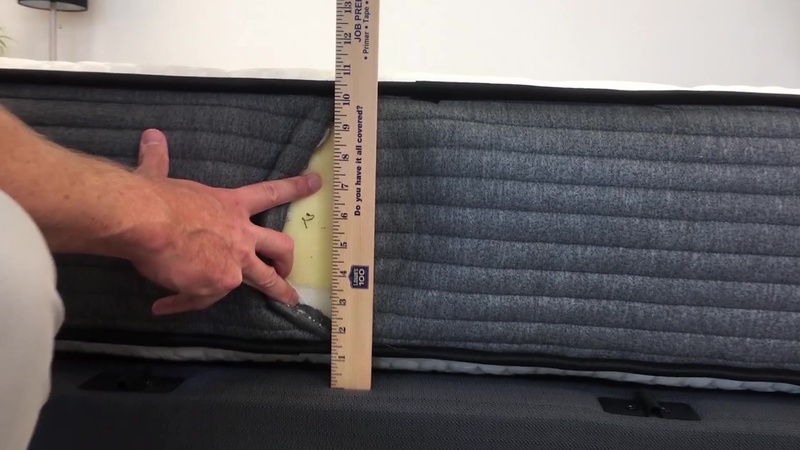
The Plank mattress isabout an 11″ thick mattress comprised of 4 layers (listed below from top to bottom, based on the mattress with the Ultra Firm side up):
3/4" foam quilted into cover
7" polyurethane support form, 1.8 lb. density
2" TitanFlex convoluted foam, 2.5 lb. density
1 1/2" foam quilted into bottom cover
The top and bottom layers of foam are quilted right into the cover; the Ultra Firm side has less quilted foam, while the slightly softer Firm side has a thicker layer of it. The middle TitanFlex foam (Brooklyn Bedding's proprietary polyurethane foam) and the support foam are similar in firmness, but the TitanFlex foam is convoluted; you may know it as "egg crate" foam--and that makes it feel softer.
Cover
The Plank mattress is wrapped in durable-feeling non-removable cover. We call this type of cover a "tight top" since it's quite tightly stretched without much loft.
Cooling Cover option
A recently added option is a cooling cover. The fabric on both sides is made with phase-change material, and is an option that adds about $125 to the price. We tried a model with the cooling cover and it did feel cool to the touch.
Phase-change material can be thought of as tiny beads filled with wax. As the wax warms, it draws heat from your body and begins to melt. The net effect is that the cover stays cooler while you are falling asleep. It doesn't always feel cool to the touch -- eventually your body will warm it up.
Durability, Warranty & Value
The “value” of any mattress is both subjective and personal –
reflecting how well it meets that person’s unique sleep needs and preferences,
relative to their budget.
As a result, our ratings in this area are focused on more objective factors like quality and longevity.
The Plank mattress is an 11-inch mattress that occupies a unique niche--aimed at those who prefer an extremely firm mattress. While the materials of its construction are not groundbreaking, this level of firmness can be hard for consumers to find, especially among online brands, which tend to hover in the "medium" range.
How Long Will the Plank Mattress Last?
When it comes to estimating the comfort lifespan of a mattress, we tend to use foam density as our best, albeit imperfect, predictor of how long a foam will retain its shape and resiliency. Most of the foams used in the Plank bed are well established in terms of predictability. The only red flag of note is the 1.8-lb foam quilted into the cover. However, there's so little of it that even if it did lose resiliency, we doubt it would be noticeable. If we had any concern, it might be for very heavy persons over 200 pounds, who might be heavy enough that the foam breaks down more quickly over time. In that case, a firm bed with an innerspring support core might be a more durable option than an all-foam bed, regardless of brand.
Overall Value
On balance, we feel that Plank mattress is an excellent value for those shopping for a very firm bed. Price wise, it sits right in line with the competition among all-foam beds that don't offer its unique firmness level.
Warranty
Warranty Length: 10 years
Indentation Coverage: 1” and above
One of the biggest, if not THE biggest complaints about any mattress from consumers regards body impressions—the inability of a mattress to spring back, eventually creating a low spot/sinkhole in the mattress. As such, mattress warranties all contain a term defining how big a sag or ‘body impression’ (measured when no one is on the mattress) is considered a defect, and thus covered under the warranty. The industry standard for mattresses is generally between ¾” and 1.5”. Brooklyn Bedding has chosen to cover indentations that meet or exceed 1” for the Plank mattress. Practically speaking, that means any softening or sagging would need to be at least that deep before the warranty would offer you protection.
Plank's manufacturer, Brooklyn Bedding, includes free delivery to your door, which is not particularly unusual among its competitors.
Returns
120-day trial period
Full refund, including return shipping within trial period
The company offers buyers a 120-day trial period, and requires that buyers try the mattress at least 30 days before returning it. Returns within the trial period are free, with return shipping included. See Brooklyn Bedding's return policy
Final Thoughts
Is the Plank bed right for you? Take our Mattress Match Quiz to find mattresses that fit your needs, based on your preferences and price range.
Looking for more on the Plank mattress? Click here to visit their website at PlankMattress.com.
How to support GoodBed
If you like the in-depth assessments and objective expertise that we provide in our reviews, please support our work by coming back to GoodBed.com whenever you're ready to buy – purchasing through most links on this site provides us with a small referral fee that supports our work at no cost to you.
“The GoodBed Quiz is by far the best starting point for any mattress shopper.”
– Katherine P. in Chicago, IL
Answer a few questions to see the best options for you based on the most advanced mattress matching algorithm on the internet.
Have you taken the GoodBed Quiz yet?
In as little as 2 minutes, this quiz will assess your unique
personal mattress requirements — including important
factors that you might not otherwise consider.
Learn more about the GoodBed Quiz.
Quickly narrow in on the best options for you (across brands and stores)
See your personal Match Score™ for any mattress listed on GoodBed
Get your top 3 online matches + top 3 matches in nearby stores
(where available)



 Comparison
 Related Video Reviews