GoodBed helps you find the best mattress for you, whether online or in a local store. If you choose to buy a product through the links on this site, we earn a small referral fee that supports our work at no cost to you. Here's more info about how it all works.
Casper was one of the pioneers of the online mattress explosion in 2014, so has one of the longer track records in the industry. Many other companies have followed suit with similar offerings, but how does Casper's flagship mattress stack up, and is it right for you?
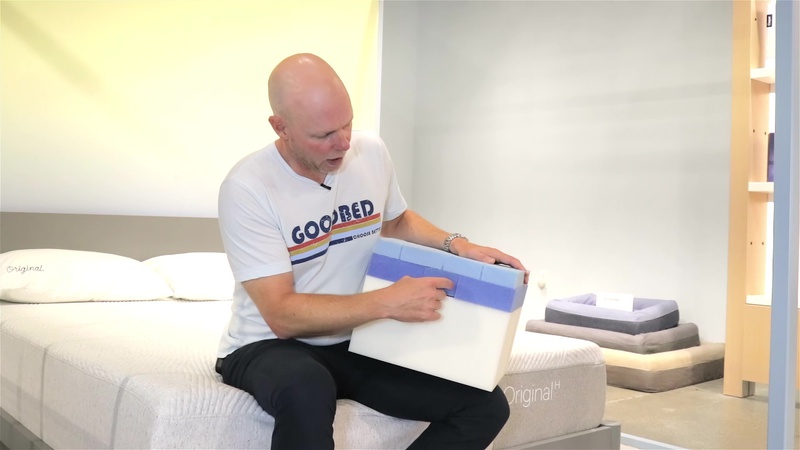
The Casper Mattress is an 11”, three-layer mattress made mainly of polyurethane foam, with the second topmost layer being memory foam. It also comes in a hybrid version, which substitutes the bottom layer of support foam with a 6" pocket spring unit. Other than providing a more bouncy feel, we found both versions to be similar in terms of softness, cushioning, and pressure relief. Here, we take a look at the foam version. Note that the cover has changed since we reviewed it.
We found the Casper Original mattress to have a Medium Firm softness level. If you prefer a feeling of floating above your mattress as opposed to sinking deeply into it, you may find the Casper bed appealing. In our tests, we found the Casper bed to offer very good support and spinal alignment, particularly for those who sleep primarily on their backs and/or stomach. Hips sunk into the mattress just enough to create a neutral spinal position, and our tester felt the mattress reaching up to support his lumbar area.
The original Casper mattress also excelled in our tests for ease of repositioning. Changing sleeping positions was virtually effortless for our tester, so if you tend to move around a lot while sleeping, the Casper mattress deserves close consideration. Motion isolation was also good; this can be a concern if you are bothered by movements of a partner, kids or pets on the other side of the bed.
While the Casper bed does have a small amount of memory foam, we would not call it a memory foam mattress, as it has none of that slow-melting-into-the-bed feel that we associate with memory foam. Rather, the Casper bed was quick-responding, and recovers its shape very quickly after being compressed.
Value-wise, the Casper bed’s competition has largely matched it in terms of product, pricing and delivery, but Casper has an extra card up its sleeve; a Casper's store locator can direct you to showrooms where you can try a Casper bed in person but pay the same competitive prices you’ll find online. For consumers nervous about buying an expensive product online sight-unseen, this could tip the decision in Casper’s favor.
If you like to sit on the edge of the bed, or tend to lie right on the edge, edge support with the Casper mattress isn’t a standout. If this is a priority for you, competing mattresses have specific features to address edge support and may be better choices.
The Casper mattress’s price is competitive; free shipping is included, but just as with any other package, it’s left at the door. A ‘white glove’ service is available as an upgrade; that means the bed would be delivered and set up in the room where you want it.
Note that the Casper mattress does not come with a box spring (nor does it need one). You can place the Casper mattress atop the support of your choice, including a separately purchased box support, a bed frame, platform bed, or adjustable bed frame. Casper sells its own bed frame and adjustable frame, but neither are required purchases.
Overall, the Casper mattress performed well in our testing and evaluations for a wide range of sleeping positions, and we felt it would also be supportive in those positions for heavier sleepers (250+ lbs.). We judged construction to be of good quality and would not have concerns about longevity.
Read on for our detailed report and be sure to check out the video to see this mattress in action as we put it through our tests.
The “feel” characteristics of a mattress cannot be universally better or worse.
They can only be more or less desirable to you, based on your personal preferences.
For this reason, we call these “preference-based” attributes.
Our ratings here are based on objective measurements that we apply to a consistent scale for products from all
brands.
Keep in mind that what mattress companies call “firm” or “soft” is a purely a preference. All mattresses should be supportive and promote healthy spinal alignment. Whether a mattress is fluffy and squishy (what mattress companies call soft or plush), or less so (what companies call firm), is purely down to your personal needs and preferences.
We classify the Casper mattress as a Medium Firm mattress, just to the firmer side of medium. The feeling you get is more of a floating-on-top sensation versus sinking deeply into the mattress.
Not sure what softness is best for you? Take our Mattress Match Quiz and find out.
This refers to how deeply you sink into the mattress or feel cradled or hugged, versus a feeling of floating on top of the bed. This is definitely more of the latter. When we place our 16-lb. bowling ball atop the mattress, it did not sink in as much as it did with some of the other mattresses we’ve recently tested. And our tester, lying on top of the bed, felt cushioning was a bit shallower than some competing mattresses with deep pillowtops and plush top layers.
If you like that feeling of being more independent of your mattress rather than being snugged in by it, we think you’ll like the Casper mattress.
Responsiveness refers to how quickly a mattress recovers its shape after being compressed. When you press your hand into the mattress, for instance, then remove it, does it take several seconds for the mattress to return to flat, or does it recover immediately?
While the Casper mattress does have a small 1.5” layer of memory foam (the second layer of the mattress), it really does not have any of that recognizable memory-foam feel, where after compressed, your hand print takes several seconds to disappear (some describe this as a slow, melting into the mattress feeling). Rather, the Casper mattress is fairly quick responding, meaning it recovers its shape quickly; not as quickly as an innerspring mattress might do, but definitely a lot faster than a memory foam mattress.
This also translates to bounce, which we test in two ways. When we dropped our 16-lb. bowling ball in the mattress, it bounced slightly. However, when our tester dropped his weight onto the bed, he did not bounce at all.
Back Support
The key to good back support is for the mattress to support your spine in a “neutral”
position while you sleep,
meaning that the shape of your spine is roughly the same as when you're standing.
The ability of any given mattress to do this will vary by sleeper,
depending on its “fit” for your weight, body shape, and preferred sleep position(s).
Lighter Weight (<150 lb.)
Side Sleeper
Back Sleeper
Stomach Sleeper
Very Good (8)
Excellent (9)
Very Good
(8)
Average Weight (150-200 lb.)
Side Sleeper
Back Sleeper
Stomach Sleeper
Very Good
(8)
Excellent
(9)
Good
(7)
Above Average Weight (200-250 lb.)
Side Sleeper
Back Sleeper
Stomach Sleeper
Good
(7)
Excellent
(9)
Good
(7)
Heavier Weight (>250 lb.)
Side Sleeper
Back Sleeper
Stomach Sleeper
Good (7)
Very Good (8)
Good
(7)
In our evaluations, the Casper mattresses afforded very good back support and spinal alignment, particularly for back and stomach sleepers. We did have some concerns, however for side sleeping. The company asserts that the Casper bed has "zoned support" with firmer form under hips and softer foam under the shoulders.
Spinal Alignment
The key to good back support is maintaining proper spinal alignment while you sleep. This means that the mattress should hold your spine in roughly the same position it's in when you're standing. The ability of a given mattress to do this will generally depend on your weight, sleep position, and body shape.
Here is how we break down the spinal alignment of the original Casper mattress:
Back Sleepers:
While our tester was on his back, he noted that his hips sank just deeply enough to create a perfectly neutral spine, while he felt the mattress did a nice job reaching up to support his lumbar curve. We feel that sleepers of a wide weight range would have a similar experience, and we did not have concerns that heavier sleepers might not be supported enough.
Side Sleepers:
Things got murkier when we evaluated side-sleeping. Our tester noted, and it’s obvious in out video, that our testers shoulders didn’t sink deeply enough into the bed, resulting in the top of his spine curving upward in this position. We’d especially question results with lighter or curvier individuals (our tester weighs just under 200 lbs.). If you are primarily a side sleeper, check our other reviews as some mattresses really do excel in this area.
Stomach Sleepers:
Achieving good spinal alignment for stomach sleepers can often be trickier as the hips can tend to sink down too far with some mattresses, but our tester felt well supported in this position as well. Even the heaviest parts of his body did not sink too much into the Casper mattress. We felt this bed would likewise be a good choice for most that sleep on their stomachs. Pressure relief in this position was also good, with not notable hot spots on knees or elbows.
Pressure Relief
Inadequate pressure relief from your mattress results in “pressure points,”
which can be a source of pain, soreness, loss of circulation, restlessness, and other problems.
Pressure relief requirements will vary be sleeper, with side sleepers needing the most.
Likewise, the amount of pressure relief that a given mattress provides will also vary by sleeper,
depending on its “fit” for your weight and body shape.
Lighter Weight (<150 lb.)
Typical Curves
Extra Curvy
Very Good
(8)
Very Good
(8)
Average Weight (150-200 lb.)
Typical Curves
Extra Curvy
Very Good
(8)
Good
(7)
Above Average Weight (200-250 lb.)
Typical Curves
Extra Curvy
Good
(7)
Pretty Good
(6)
Heavier Weight (>250 lb.)
Typical Curves
Extra Curvy
Good
(7)
Pretty Good
(6)
Overall, we found the pressure relief offered by the Casper mattress to be good. Our tester didn’t experience any specific issues, and he didn’t feel that he ‘bottomed out’ or pushed through the mattress’s comfort layers and into the firmer support foam layers. However, we do wonder about heavier or curvier people, whose hips and shoulders could possibly sink through those top layers to the harder support layers of foam.
Performance Features
With the “features” of a mattress, performance will tend to be consistent across all sleepers –
without regards to your body type or preferences.
However, these attributes have differing levels of importance to each sleeper,
which is why we consider them “priority-based” characteristics.
With a bowling pin standing upright on the Casper bed, we tested motion isolation by dropping a 16-lb. bowling ball on it, as well as the whole weight of our 200-lb. tester.
In the bowling ball test, the bowling pin wiggled but didn’t fall. And when our tester dropped his entire weight onto the Casper bed, the pin barely moved. Why did the pin move more with the lighter weight than the heavier weight? The cover comes into play here. The Casper’s cover is taut and not very stretchy; when you press on the surface of the bed, the fabric moves towards your hand rather than stretching into the hole. Practically speaking, this doesn’t mean much in terms of comfort; it’s just a characteristic of the bed, and explains why we saw some surface movement/shifting.
We felt that the Casper bed would be a good choice for couples who don’t want to feel their partner getting in and out of bed.
For most people, we do not think the Casper mattress will feel hot. Memory foam has a reputation for heat retention, but in the case of the Casper bed, the memory foam layer is not on top. And because the Casper is a firmer bed, your body doesn’t sink so deeply into in, leaving more of your body exposed to air and able to dissipate heat.
The top layer of foam is pierced with pin core holes, drilled right through the foam, intended to provide some air flow.
If overheating in bed is an issue for you, and you’ve experienced it with other mattresses, other models have features that are specifically intended to address this, but for most we don’t expect heat to be a major problem with the Casper bed. The company says its open-cell foams promote better air flow.
Foam mattresses aren’t typically very supportive along the very edge of the mattress—important if you like to sit on the edge of the bed, or if you tend to sleep along the edge. With the Casper mattress, our tester did experience a substantial amount of dip when sitting on the edge of the mattress, but he did feel stable.
When laying on the very edge of the mattress, however, our tester felt his body starting to lean off the edge once he began to warm up and soften the memory foam layer. Overall, if you spend a lot of your sleep time right on the edge of the bed, other mattresses might be a better fit.
One of the highlights of the Casper mattress, for our tester, was ease of movement, which owing to the high responsiveness and elasticity of the gel layer, was almost effortless. If you tend to change positions a lot, the Casper mattress performed extremely well in our view.
For mattress shoppers concerned with the use of natural materials, sustainable manufacturing practices or the like, we offer our subjective evaluation of any efforts taken by the company to make the mattress more green, healthy, or safe.
In the case of the Casper mattress, the company makes no claims about the use of natural materials. All of its foams are petroleum-based, and chemical glues are used to hold the mattress together.
All of the foams used are certified to the CertiPUR-US standard, which verifies that a material has low VOC off-gassing as well as a lack of chemicals and other substances regulated by the CPSC. This is now a very common certification we see on most mainstream beds. We do like that the Casper website includes a page on Casper's certifications.
We did not specifically test the Casper bed with an adjustable base. However, the company sells its own adjustable base that can be used with the Casper bed, and using an adjustable base (either Casper’s or another brand’s) will not void the warranty. Since the company endorses use of adjustable bases, we assume that compatibility is likely good.
Materials & Construction
What is in The Casper Mattress?
Overall, we classify the original Casper mattress as a "Comfort Foam + Memory Foam over Foam" construction type.
The Casper mattress isan 11″ thick mattress comprised of 4 layers (listed below from top to bottom):
2" polyurethane foam
2" memory foam
7" polyurethane foam support layer
The Casper mattress is made of three foam layers stacked together. The topmost comfort layer is a standard polyurethane foam, with pin core holes drilled through it to promote air flow.
The second layer is memory foam, and it includes a feature intended to improve support and spinal alignment: The central third part of the memory foam layer features a firmer foam in the hip area.
A 7" support core of standard foam forms the lowest layer.
Cover
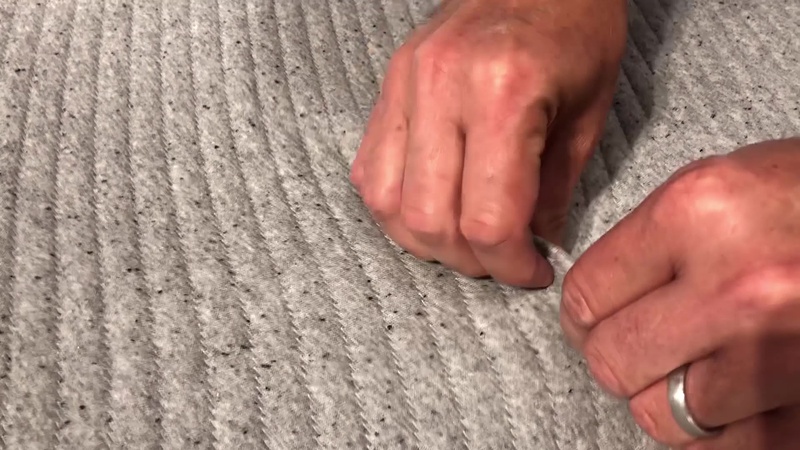
The four layers of the Casper mattress are wrapped in a very soft cover that has a knit quality to it. It's not quilted, but does have some decorative linear stitching, along with little fiber slubs that give it some texture. The side panels especially feel substantive and thick.
Durability, Warranty & Value
The “value” of any mattress is both subjective and personal –
reflecting how well it meets that person’s unique sleep needs and preferences,
relative to their budget.
As a result, our ratings in this area are focused on more objective factors like quality and longevity.
Durability
Good (7)
Warranty
10-year warranty
Quality
Good (7)
How Much Does the Casper Mattress Cost?
Prices shown are list prices. Remember that GoodBed keeps our site current with the best available discounts on all online mattresses, many of which are exclusive discounts for our readers. This is an exclusive discount for our readers, and also provides GoodBed with a small referral fee from Casper that supports our work at no cost to you.
What Are You Getting?
The Casper is an 11-inch mattress made of polyurethane foam with varying densities, along with a 2” layer of memory foam sandwiched as the second layer. As one of the very first, if not THE first companies selling mattresses online, Casper has a long track record in the industry. And recognizing that some people still prefer to try a mattress in person, Casper has opened a number of showrooms where you can try out and buy their products. Casper products are also in a number of Target stores as well.
How Long Will the Casper Mattress Last?
When it comes to estimating the comfort lifespan of a mattress, we tend to use foam density as our best, albeit imperfect, predictor of how long a foam will retain its shape and resiliency. In the case of the Casper mattress, the foams used are mainly standard polyurethane foam, which generally has a good track record for longevity. If we have any concerns, it’s the 2” layer of memory foam with 3.5-lb. density, which is a little lower than we like to see. Overall, though, we do believe the Casper bed will hold up well.
Overall Value
When Casper first hit the market, it was a revolutionary sales model and product, and at the time was an exceptional value, especially compared to traditional mattress stores. These days, the competition has caught up, and policies pioneered by Casper, like free delivery and returns, are now standard practice.
Pricing for the Casper is right in line with many, if not most, of its online competitors, some of which offer more sophisticated mattresses for the same price. While the Casper bed was an exceptional value when it debuted, it doesn’t stand out quite as much for value. Even so, it still compares very well to foam beds you’ll find in mattress stores.
And if you prefer to try a mattress in a store, Casper showrooms offer just that, allowing you to test in person but still take advantage of online pricing. Casper also offers a 10% discount to active duty and retired military and their spouses.
Warranty
Warranty Length: 10 years
Indentation Coverage: 1” and above
One of the biggest, if not THE biggest complaints about any mattress from consumers regards body impressions—the inability of a mattress to spring back, eventually creating a low spot/sinkhole in the mattress. As such, mattress warranties all contain a term defining how big a sag or ‘body impression’ (measured when no one is on the mattress) is considered a defect, and thus covered under the warranty. The industry standard for mattresses is generally between ¾” and 1.5”. Casper has chosen to cover indentations that meet or exceed 1”. Practically speaking, that means any softening or sagging would need to be at least that deep before the warranty would offer you protection. See: Casper warranty details
Other Factors to Consider
Delivery
Free delivery
Optional white-glove service
Casper includes free delivery, which is not particularly unusual among its competitors. For an extra $149, you can opt for their VIP or ‘white glove’ service, where the mattress is delivered and set up in the room where you want it, and the packaging is removed. Removal of your old bedding is also included if desired.
Returns
100-day trial period
Full refund, including free pickup within trial period
Casper offers buyers a 100-day trial period. Returns within the trial period are free, with pickup of the mattress included. Returned mattresses will be donated to charity, according to the company. Get the full return-policy details.
Final Thoughts
Is the Casper bed right for you? Take our Mattress Match Quiz to find mattresses that fit your needs, based on your preferences and price range.
Looking for more on the Casper mattress? Visit Casper.com.
How to Support GoodBed
If you like the in-depth assessments and objective expertise that we provide in our reviews, please support our work by coming back to GoodBed.com whenever you're ready to buy – purchasing through most links on this site provides us with a small referral fee that supports our work at no cost to you.
“The GoodBed Quiz is by far the best starting point for any mattress shopper.”
– Katherine P. in Chicago, IL
Answer a few questions to see the best options for you based on the most advanced mattress matching algorithm on the internet.
Have you taken the GoodBed Quiz yet?
In as little as 2 minutes, this quiz will assess your unique
personal mattress requirements — including important
factors that you might not otherwise consider.
Learn more about the GoodBed Quiz.
Quickly narrow in on the best options for you (across brands and stores)
See your personal Match Score™ for any mattress listed on GoodBed
Get your top 3 online matches + top 3 matches in nearby stores
(where available)




 Comparison
 Related Video Reviews